Optometry 360
  • Home
  • Conferences
  • Videos
  • About Us
    • About Us – Mission
    • Media Partners
    • Advisory Board
    • Industry Council
    • Business Team

What are you looking for?

  • Conference Roundup
  • Contact Lenses
  • Diagnostics
  • Glaucoma
  • Myopia
  • Neurotrophic Keratitis
  • Ocular Surface Disease
  • Pediatrics
  • Practice Management
  • Presbyopia
  • Retina
  • Spotlight Series
The evolving role of the optometrist in nonsurgical cataract management
Optometry 360
  • Home
  • Conferences
  • Videos
  • About Us
    • About Us – Mission
    • Media Partners
    • Advisory Board
    • Industry Council
    • Business Team
Home > Reference database size affects OCT glaucoma flag classifications
  • Glaucoma

Reference database size affects OCT glaucoma flag classifications

Kelsey Moroz

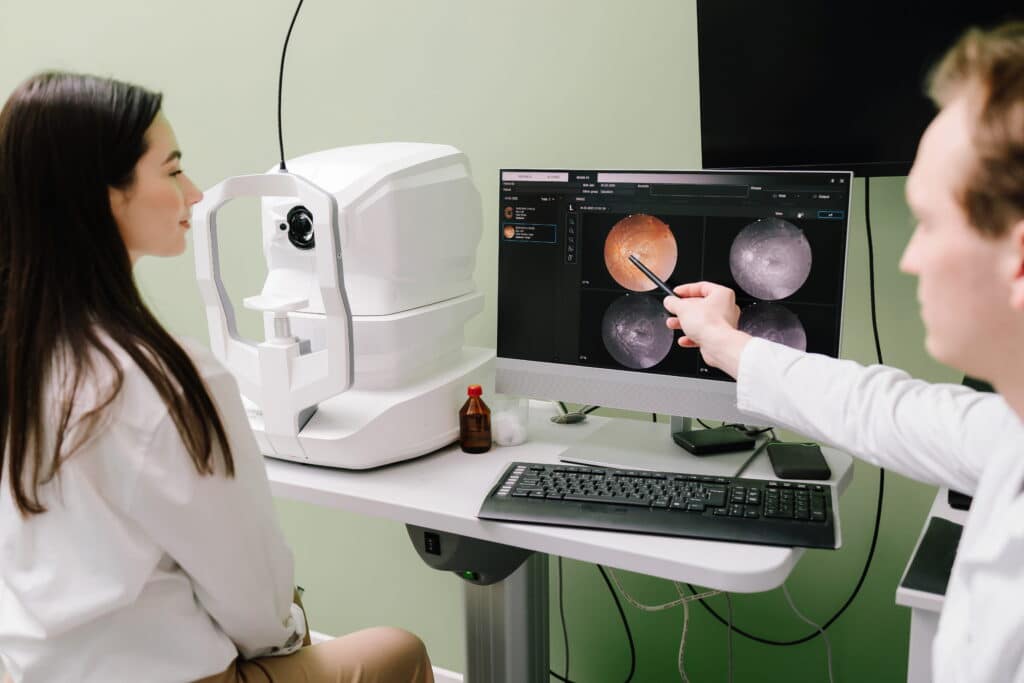
A larger real-world optical coherence tomography (OCT) reference database flagged some glaucoma eyes differently than a smaller commercial database, according to a study.

Researchers analyzed a commercial reference database (C-RDB) containing 398 eyes and a larger real-world reference database (RW-RDB) containing 4,830 eyes collected from optometry practices using a reading center method.

The databases were then applied to a test dataset of 175 healthy eyes and 183 eyes with OCT findings consistent with optic neuropathy–glaucoma. Eyes were flagged as yellow if values fell below the fifth percentile and red if they fell below the first percentile.

The databases did not flag the same eyes. Among the 183 glaucoma eyes, 16% differed in color classification for global circumpapillary retinal nerve fiber layer and 7% differed for global ganglion cell layer plus inner plexiform layer. Additional modeling and Monte Carlo simulations suggested that both databases were sampled from essentially the same underlying normal population, but that the larger RW-RDB reduced random error.

Reference
Hood DC, Durbin M, Lee C, et al. Larger Real-World OCT Reference Database Improves Accuracy of Glaucoma Flagging Using Summary Metrics. Transl Vis Sci Technol. 2026;15(3):6. doi: 10.1167/tvst.15.3.6. PMID: 41800850.

Share

Related Content

  • Glaucoma

AOA 2026: Surgical and technological advances to improve quality of life and reduce drop burden in glaucoma

  • Glaucoma

Ocular surface health may play a key role in glaucoma treatment adherence

  • Glaucoma

Poor sleep quality linked to glaucoma severity in older adults

  • Diagnostics

Diabetes linked to higher risk of ulcerative keratitis in US study

  • Glaucoma

Community-based vision screening highlights unmet glaucoma care needs among seniors

  • Glaucoma

Review highlights potential role of electrophysiology in early glaucoma detection

Share

Advisory Board

Kaleb Abbott, OD, MS, FAAO

Clark Chang, OD

Jessica Haynes, OD, FAAO, FORS, Dipl ABO

Monica Kalia, OD

Cecelia Koetting, OD, FAAO, DipABO

Roya Attar, OD, MBA, DHA, FAAO

Hardeep Kataria, OD, FAAO

Marc R. Bloomenstein, OD, FAAO

Elise Kramer, OD

See All
Optometry 360

Optometry 360® is a dynamic digital platform dedicated to advancing the field of eye care.

Get to Know Us

  • Home
  • About Us
  • Media Partners
  • Advertising Policy
  • Our Advisory Board

Sign up for our Newsletter

Sign up for our Newsletter to get our newest articles instantly!

  • Privacy Policy
  • Advertising Policy
  • Medical Disclaimer
IHM Logo

© 2026 Optometry 360 is a trademark of International Healthcare Media, LLC. All rights Reserved

  • MedJournal360 Icon
  • RareDisease360 Icon
  • MyHero360 Icon
  • Optometry360 Icon
  • Ophthalmology360 Icon