Optometry 360
  • Home
  • Conferences
  • Videos
  • About Us
    • About Us – Mission
    • Media Partners
    • Advisory Board
    • Industry Council
    • Business Team

What are you looking for?

  • Conference Roundup
  • Contact Lenses
  • Diagnostics
  • Glaucoma
  • Myopia
  • Neurotrophic Keratitis
  • Ocular Surface Disease
  • Pediatrics
  • Practice Management
  • Presbyopia
  • Retina
  • Spotlight Series
The evolving role of the optometrist in nonsurgical cataract management
Optometry 360
  • Home
  • Conferences
  • Videos
  • About Us
    • About Us – Mission
    • Media Partners
    • Advisory Board
    • Industry Council
    • Business Team
Home > Post-menopausal women show more severe evaporative dry eye disease
  • Ocular Surface Disease

Post-menopausal women show more severe evaporative dry eye disease

Ophthalmology 360

Key Takeaways

  1. Post-menopausal women had the highest prevalence of severe DED and more pronounced signs of evaporative dry eye than age-matched men and younger women.
  2. Burning symptoms were the strongest predictor of severe DED in multivariable analysis.

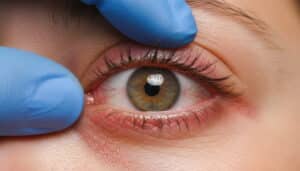
Post-menopausal women experienced more severe dry eye disease (DED) than age-matched men and younger women, according to a study.

The study included 319 participants including 102 post-menopausal women, 105 age-matched men, and 112 younger healthy women.

Post-menopausal women had significantly higher Ocular Surface Disease Index (OSDI) scores, shorter tear breakup time, greater corneal and conjunctival staining, and more severe meibomian gland dysfunction than the comparison groups. Burning and itching symptoms were also reported more frequently.

Severe DED was identified in 24.5% of post-menopausal women compared with 16.2% of age-matched men and 18.8% of younger women. Multivariable analysis identified burning symptoms as the strongest predictor of severe DED, while post-menopausal status and lid-margin changes were associated with smaller increases in risk.

Reference

Pandey H, Kumar R. Impact of menopause on dry eye disease: a cross-sectional comparative study. Post Reprod Health. 2026;doi: 10.1080/20533691.2026.2659566. Epub ahead of print. PMID: 42484415.

Share

Related Content

  • Ocular Surface Disease

Dry eye diagnostic practices remain inconsistent worldwide, survey finds

  • Ocular Surface Disease

Spotlight on VEVYE®

  • Ocular Surface Disease

Intervening early in dry eye disease: reducing patient cost and disease burden

  • Ocular Surface Disease

Consensus guidance helps identify misdiagnosed demodex blepharitis

  • Ocular Surface Disease

Advancing dry eye care through personalized treatment

  • Ocular Surface Disease

Head strap reduced eyelid heating in warming eye mask study

Share

Advisory Board

Kaleb Abbott, OD, MS, FAAO

Clark Chang, OD

Jessica Haynes, OD, FAAO, FORS, Dipl ABO

Monica Kalia, OD

Cecelia Koetting, OD, FAAO, DipABO

Roya Attar, OD, MBA, DHA, FAAO

Hardeep Kataria, OD, FAAO

Marc R. Bloomenstein, OD, FAAO

Elise Kramer, OD

See All
Optometry 360

Optometry 360® is a dynamic digital platform dedicated to advancing the field of eye care.

Get to Know Us

  • Home
  • About Us
  • Media Partners
  • Advertising Policy
  • Our Advisory Board

Sign up for our Newsletter

Sign up for our Newsletter to get our newest articles instantly!

  • Privacy Policy
  • Advertising Policy
  • Medical Disclaimer
IHM Logo

© 2026 Optometry 360 is a trademark of International Healthcare Media, LLC. All rights Reserved

  • MedJournal360 Icon
  • RareDisease360 Icon
  • MyHero360 Icon
  • Optometry360 Icon
  • Ophthalmology360 Icon